Community Action for Rural Development Nepal (CARD Nepal)
Introduction :
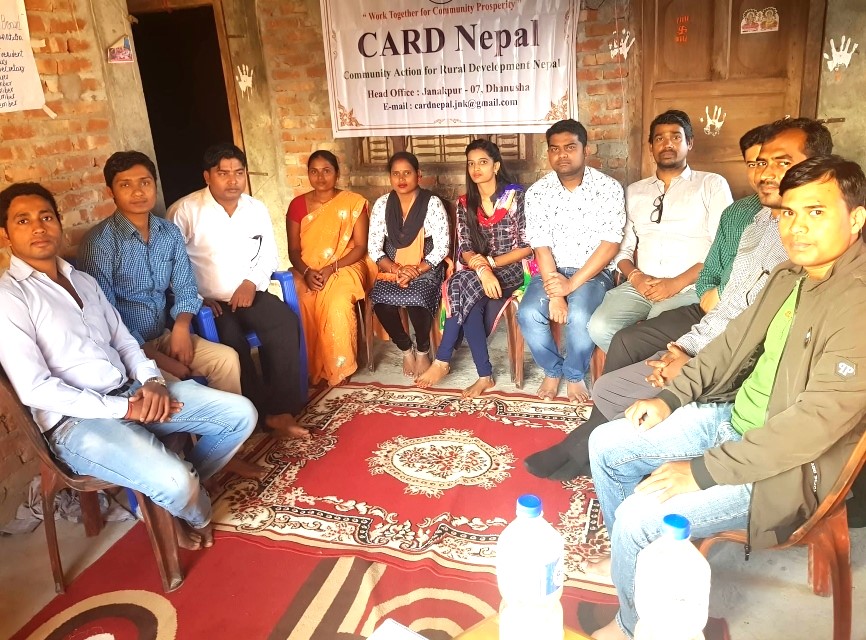
Community Action for Rural Development Nepal (CARD Nepal) is a community based Non-political, Non- profit making, Non-religious, Non- Governmental Organization (NGO). CARD Nepal is established by Group of youth devoted towards social work with slogan “Work Together for Community Prosperity”
CARD Nepal is formally registered under organization registration Act. 2034 of Nepal in District Administration Office, Dhanusha in 2074 BS. (2018 AD.) with Registration No. 2352 and is affiliated with Social Welfare Council, Nepal under section 13 of the social welfare Act. 1992 with affiliation No. is 47690. and Its PAN no is 607689790.
Social Justice, equality, accountability and transparency towards beneficiaries, stakeholders and donors are the features of CARD Nepal. Due to these characteristics CARD Nepal succeeds to win conviction and acceptance of all community, stakeholders and donors. The hard work, dedication, financial transparency and commitment of the young and dynamic organization members have helped the organization to maintain its steady growth trend.
What We Do ?
- We are a profitless, public interest social organization. We organize classes, training, and skill development programs for vulnerable and minority communities, including women, disabled, Madheshi, Muslim, Janjati and Dalit groups, to make them educated and self-sufficient. Emphasizing technical education, we address unemployment through skill development and self-employment programs.
- Our environmental and WASH programs focus on improvement, pollution control, disaster management, natural resources, climate change effects, clean drinking water, sanitation and personal hygiene programs.
- We improve education, child rights, child protection and child marriage mitigation with the help of various organizations, enhancing the livelihoods of children and teenagers.
- We conduct and monitor initiatives and research to defend human rights, conflict management and address civil rights violations.
- Our tourism promotion efforts include conducting activities and identifying challenges in the sector.
- Our Agriculture program focused on identifying and addressing challenges in the agriculture sector through coordination with various bodies to promote sustainable growth and development through agriculture financing, conducting programs on equipment and Modern business Oriented farming techniques.
- Additionally, we engage youth in financial literacy and life skills, and support women empowerment, financial literacy , LGBTQ rights, and migrants wellbeing through various projects and initiatives.
Our Target

Adolescents
Adolescents in Nepal, Aged 10 to19 face significant challenges in education, health & safety, including limited access to quality education, health, GBV, child labor & substance abuse. Addressing these issues with comprehensive strategies is crucial for fostering a nurturing environment that allows them to grow into healthy, educated & empowered individuals who can contribute to Community & Nepal prosperity future.

Women
Nepal's patriarchal society severely discriminates against daughters, leading to limited rights, education & property ownership, which contributes to economic disempowerment and psychological harm. With only 66.8% of girls enrolled in secondary education compared to 75.1% of boys, and women owning just 19.7% of land & property, need for legal reforms, improved education, economic empowerment & cultural shifts is urgent.

Youth
Nepal's youth, constituting 40.68% of the population aged 16 to 40, confront challenges in education, health & employment, including limited access to quality education, health disparities and high unemployment rates despite migration-driven remittances. Reforms in education, healthcare, and economic policies are essential to foster local job creation, protect migrant workers and empower youths through education & skills training for sustainable development.

Children
Almost 40% of Nepal’s population is under the age of 18 years. With provincial and local governments being new establishments in Nepal, it's essential to establish functions related to children at these 2 levels of Government. Investing in children is crucial not only for national development but also for upholding children's rights, safety and fostering a more inclusive society poised for sustainable progress of Nepal.

LGBTQ
Despite legal recognition since 2007 and inclusion of sexual minorities in the national census, LGBTQ individuals in Nepal face deep-seated discrimination in labor market, education & healthcare. With an estimated 9 Lakhs LGBTQ, societal attitudes remain largely negative, resulting in widespread social repudiation & marginalization, even within their own families. Addressing these issues is vital for ensuring rights.

People with Disability
Disability is a condition where a person feels difficulty to perform day to day activities & participate fully in social life due to problem in body, organs & system including physical, socio-cultural, communication barriers. Prevalence of disability is 2.2% in total population of Nepal (CBS 2021). Individuals with disabilities often face higher rates of poverty & greater constraints on their livelihoods compared to general population.

Poor, vulnerable & Marginalized
Nepal faces significant challenges with 21.6% of its population living below the poverty line. Vulnerable groups, such as Dalits, indigenous peoples, experience higher rates of poverty and discrimination. We are putting our efforts must be made to ensure that these groups have equal access to education, healthcare, employment, and legal protections, and that their voices are heard in decision-making processes.

Farmers
Farmers in Nepal, who make up about 66% of the population and contribute around 27% to the GDP, face numerous challenges, including traditional farming practices, inadequate infrastructure, limited financial access, market access issues, and climate vulnerability. Only 28% of agricultural land is irrigated, and less than 40% of farmers have access to formal financial services. Agriculture not only to mitigate hunger, also to reduce the environment & climate related issues.

Migrant and Migrant Family
Migrants play a crucial role in Nepal's economy, with remittances making up about 25% of GDP. Over 2 million Nepalese work abroad, mainly in Middle East, Maleysia India etc. bolstering their main source of income. However, migrant workers face problems as exploitation, unsafe conditions, use of income in unproductive sector and family separation. Internal migrants also encounter inadequate living conditions in urban areas.
Our Funding Agencies and Network Alliances
;


Founded in 2074
Founded in 2074
Creation of prosperous society and ensure the equal access in health, quality education, human rights, child rights and minimize the discrimination through socio-economic empowerment & women's empowerment as well as work on environment, WASH, sanitation, clean drinking water supplies, agriculture and tourism.
To improve the lives of marginalized communities, ultra-poor, socially oppressed strata and peasants through promotion of social cohesion, human rights, health awareness, education awareness, scientific agriculture, economic empowerment, environment, clean drinking water supply and sanitation as well as sustainable management of natural resources.

Our History
Our History
Community Action for Rural Development Nepal (CARD NEPAL) was founded by a group of youth devoted to social work and respect to Environment as well as to agriculture having rural background. We were seeing, people didn't show welcoming behavior to farmers nor sufficient respect to Environment. That behaviours made us to think, what we can do for this situations. Some of us were support the Agriculture melas and plantation programs as volunteer. People were misbehaving with the social excluded & ultra-poor and tried to oppress them. Some of the places were facing clean drinking water supply and WASH problems. Similarly drop rate of girl were increasing because of mensuration problem, separate washroom for girls, child marriage.
In A.D. 2015 there were earthquake in Nepal. We donated some Money and raw food materials for relief to those who affected from earthquake. But we felt, that was not well managed effort. So we worked to establish a NGO. Latter we established a NGO Named Community Action for Rural Development Nepal (CARD NEPAL) in 2074 B.S. (2017 A.D.)

Large Community
Large Community
A locally registered organization as non-profit making organization (at district administration office, Dhanuhsa in 2074). A pioneer organization having 6 years of proven experience through implementing its 17 diverse and different kind of projects with different funding agencies including individuals' donations.